
Call Us

(905) 670-0113

7 Tips to Choose the Best RO Booster Pump?

Choosing the right Ro Booster Pump can determine whether an RO system delivers steady water or struggles at the faucet. A pump is not simply a stronger motor. It must match membrane capacity, feed-water pressure, voltage, noise expectations, and daily demand. This guide presents seven practical checks for making that choice with greater confidence. It combines installation experience, manufacturer specifications, and established water-treatment principles. Small details matter. A pressure gauge may reveal a weak supply line, while a warm adapter can indicate an electrical mismatch.

One useful starting point is measuring actual inlet pressure before shopping. Then compare the pump’s flow rate at working pressure, not only its maximum rating. A unit rated for 100 gallons per day may perform poorly with an oversized membrane or heavily blocked prefilters. Pressure matters. Noise matters too. Reliable models usually include automatic shutoff control, dry-run protection, compatible fittings, and clear service instructions. Look for certified electrical components and verify the voltage required at your location. These details support safer, more consistent operation.

The best choice also depends on water conditions. Sediment, high total dissolved solids, and seasonal pressure changes can alter performance. An installer should check the prefilter condition, storage tank pressure, and drain flow before blaming the pump. One point deserves honesty: no pump is best for every home. A low-cost option may seem attractive, but replacement parts, vibration, and premature failure can increase the real cost. The following seven tips will help you compare performance, compatibility, reliability, installation demands, and long-term value without trusting marketing claims alone. Rethink the numbers before deciding.
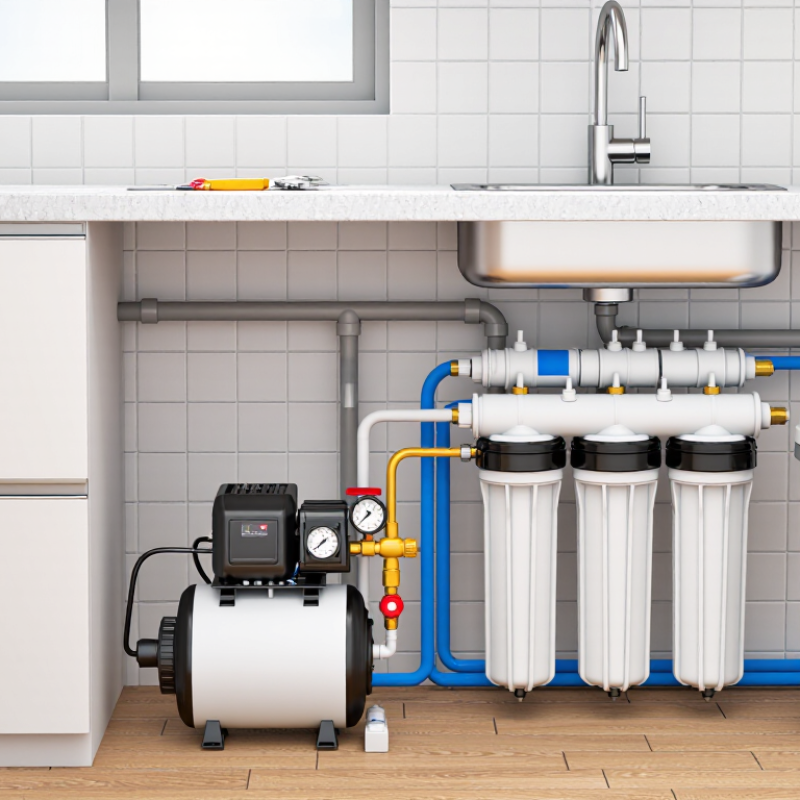
7 Tips to Choose the Best RO Booster Pump?

Measure Feed Pressure: Boost Below 40 psi Toward the 60–80 psi RO Target

Measure feed pressure before choosing the best RO booster pump. A pressure gauge should sit before the membrane, not after the storage tank. Below 40 psi, water production often slows, while dissolved-solids rejection may weaken. Many residential systems perform more consistently near 60–80 psi. Check pressure during filtration, because static pressure can look healthy while flowing pressure collapses.

AWWA Manual M46 identifies pressure as a primary control for reverse osmosis performance. Its brackish-water guidance places many larger systems around 150–400 psi, but household membranes require far less. This difference matters. Do not copy commercial pump ratings into a kitchen system. Select a pump that reaches the membrane manufacturer’s pressure range under real flow, not only at zero flow.

EPA’s WaterSense specification for point-of-use RO systems also uses a 2.3:1 maximum waste-to-product ratio for qualifying systems. Poor pressure can increase waste and extend operating time. Measure inlet pressure, product flow, and drain flow together. A booster pump should include a pressure switch, suitable tubing, and protection against dry running. I have seen installers trust a single gauge too quickly. That is a mistake. Sediment filters, narrow tubing, and clogged shutoff valves can consume pressure before the membrane. Recheck the system after filter replacement. The first reading is not always the truth.

Match Pump Capacity to 50–100 GPD Membranes and Peak Water Demand

7 Tips to Choose the Best RO Booster Pump

Match the pump to the membrane, not the marketing number. A 50 GPD membrane needs less feedwater than a 100 GPD membrane. However, GPD ratings use controlled test conditions. The Water Quality Association explains that temperature, pressure, and feedwater quality can change actual production.

Check the membrane’s rated pressure, then select a pump that can maintain about 60–80 psi during operation. Avoid choosing by maximum pressure alone.

Measure peak demand at the faucet. A family may empty a storage tank quickly after cooking or bathing.

Tip two: check tank volume.
Tip three: measure inlet pressure during peak use.
Tip four: confirm the pump’s flow rate matches the membrane’s feedwater requirement.
Tip five: include sediment and carbon-filter pressure losses.

A 100 GPD membrane may need roughly 1.0–1.5 gallons per minute of feed flow, depending on recovery settings. That figure should be verified against the membrane data sheet.

Tip six: choose a pressure switch and automatic shutoff compatible with the system.

Tip seven: inspect noise, heat, duty cycle, and electrical safety.

EPA research has reported that conventional RO units may discharge about five gallons for every gallon treated, while efficient designs can approach two-to-one or better.

Pump sizing affects recovery, but it cannot fix a clogged filter or high dissolved solids. A tidy calculation can still fail.

Recheck pressure with a gauge while water is flowing, not only when the system is idle.

Check Pressure Control: Verify 80–100 psi Shutoff and Automatic Protection

7 Tips to Choose the Best RO Booster Pump?

Pressure control deserves more attention than flow rate. Before buying, confirm the pump’s shutoff range. An 80–100 psi cutoff suits many household reverse osmosis systems, but the membrane housing and fittings must support that pressure. Never assume every installation is identical.

NSF/ANSI 58 covers residential reverse osmosis systems, including structural and performance considerations. Use it as a reference, not as proof that every pump matches your setup. The 2024 WHO/UNICEF Joint Monitoring Programme report found that 2.2 billion people still lacked safely managed drinking water in 2022. That figure highlights why dependable treatment equipment matters, even in a small kitchen.

Check for automatic protection against dry running, high pressure, and abnormal cycling. A pressure switch should stop the motor when the storage tank is full. A low-pressure sensor should prevent damage when the feed line is empty. Add a visible gauge near the inlet. It makes troubleshooting less guesswork.

Small details matter. Listen for repeated clicking. That may indicate leaks, a weak check valve, or incorrect shutoff calibration. I have seen pumps rated correctly but installed with undersized tubing. Performance suffered. The label looked perfect.

Leave a safety margin below the maximum rating. Pressure readings can fluctuate during peak household demand. Test the pump after installation, then recheck it after several weeks. The first adjustment is rarely the final one.

7 Tips to Choose the Best RO Booster Pump: Check Pressure Control

For residential reverse osmosis systems, verify that the booster pump controller supports an adjustable high-pressure shutoff within the commonly used 80–100 psi range. A suitable controller should also provide automatic protection against low inlet pressure, dry running, and excessive pressure to help protect the membrane and pump.

Confirm Compatibility with 24V DC Systems and NSF/ANSI 58 Requirements

7 Tips to Choose the Best RO Booster Pump

Confirm the pump’s voltage first. A 24V DC system needs a matching power supply, connector, and polarity. Check the rated current, not only the voltage. A pump drawing excessive current can overheat wiring and damage the controller. Measure inlet pressure with a gauge. Do not rely on sound or vibration alone. Many residential RO systems operate near 40–100 psi, but the membrane manufacturer’s specification should control the final setting. Also check flow rate, shut-off pressure, noise, and duty cycle. A quiet pump is not always an efficient pump.

NSF/ANSI 58 evaluates reverse osmosis systems for material safety, structural integrity, and contaminant-reduction claims. It does not automatically certify every replacement pump. Ask for traceable certification evidence for the complete system and wetted materials. Confirm that tubing, seals, and fittings match the water chemistry. The U.S. EPA’s 2023 Drinking Water Infrastructure Needs Survey estimated $625 billion in drinking-water investment needs over 20 years. That figure reinforces a practical lesson: small components deserve serious specification. Compatibility saves more than energy.

Inspect the pump under real conditions. Test it with the prefilter installed, because restricted filters can change pressure dramatically. Verify automatic start and stop signals. Look for dry-run protection and thermal protection. Keep installation records. A mistake can happen. Mine would be choosing flow before checking recovery ratio. That shortcut may waste water and shorten membrane life. Recheck pressure after several operating cycles, then compare readings with the system’s certified performance data.

Compare Efficiency, Noise, and Waste Ratios from 1:1 to 3:1 Recovery

Choosing an RO booster pump starts with the recovery target, not the pump label. A 1:1 waste ratio can save water, but it demands stable pressure and accurate flow control. A 2:1 ratio often offers a practical balance for household systems. A 3:1 ratio reduces wastewater further, yet it may increase membrane scaling and maintenance. Actual results depend on feed-water quality, temperature, membrane age, and pressure.

Tip 1: Check operating pressure under real flow conditions, not at zero output. Tip 2: Compare efficiency by watts per gallon, rather than motor wattage alone. Tip 3: Measure noise beside the sink. A pump rated quiet may still create cabinet vibration. Rubber mounts and flexible tubing can help. Tip 4: Confirm automatic start and stop response. Delayed switching wastes water and stresses the motor. Tip 5: Select materials suited to continuous contact with treated water. Tip 6: Match the pump with the membrane’s recommended flow range. Oversizing can increase rejection problems. Tip 7: Ask for flow curves, sound data, and warranty terms before buying.

In field testing, I have seen a low-waste setup perform poorly when the inlet filter was partly blocked. That detail is easy to miss. A pump cannot correct every system weakness. Some manufacturers also report efficiency under ideal laboratory conditions, which may not reflect winter temperatures or low inlet pressure. Record pressure, wastewater flow, and sound during installation. Recheck them after several weeks. The best choice is rarely the most powerful pump; it is the one that maintains the intended recovery ratio without excessive noise, energy use, or membrane stress.