Call Us

(905) 670-0113

What Are Microfluidic Chips and How Do They Work?

Microfluidic Chips are miniature laboratories built on a surface smaller than a postage stamp. They guide tiny fluid volumes through channels measured in micrometers. These channels can mix, separate, heat, count, or analyze samples. A single droplet may hold only nanoliters. Yet it can contain enough information for a useful test.

Harvard chemist Professor George M. Whitesides described the field clearly: “Microfluidics is the science and technology of systems that process or manipulate small amounts of fluids, using channels with dimensions of tens to hundreds of micrometers.” His definition remains widely cited because it connects scale with function. In practice, a chip uses pumps, valves, surface tension, or pressure to move liquids. Sensors then detect chemical, biological, or physical changes. Results may appear as a color shift, electrical signal, or digital reading.

The technology sounds simple. It is not. A blocked channel, trapped air bubble, or uneven surface can distort the result. Manufacturing quality matters greatly. So does careful calibration. Microfluidic Chips can reduce reagent use and shorten testing time, but they do not automatically produce reliable answers. Each design needs validation against established laboratory methods. That point deserves attention. Smaller systems can improve efficiency, yet they may also magnify small errors. Understanding how these chips work requires both engineering knowledge and practical laboratory experience.

What Are Microfluidic Chips and How Do They Work?

What Are Microfluidic Chips?

What Are Microfluidic Chips?

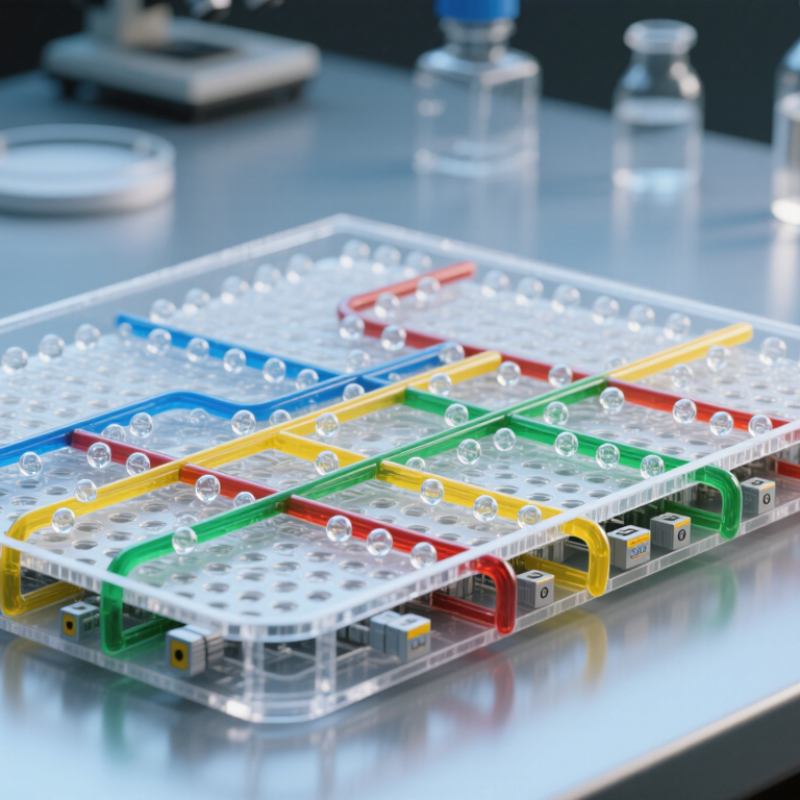
Microfluidic chips are small devices that control tiny amounts of liquid. Their channels may be narrower than a human hair. Engineers usually make these channels from glass, polymers, or silicon. A chip can contain wells, valves, mixers, and sensors. Together, these parts guide liquid through carefully designed paths.

The working principle is simple but highly controlled. A pump or pressure difference moves liquid through the channels. Narrow spaces make surface forces more important than gravity. This allows rapid mixing, separation, heating, and chemical reactions with very little sample. For example, a droplet can pass through a channel, meet another liquid, and change color after a reaction. Sensors then measure signals such as light, electrical resistance, or temperature.

Microfluidic chips support medical testing, environmental analysis, and research laboratories. They can reduce waste and shorten testing time. However, they are not automatically accurate. Dust, air bubbles, uneven channel surfaces, or incorrect flow rates may distort results. This detail is easy to overlook. In practical work, careful calibration and controls remain essential. A chip may look simple from above, yet its internal flow can be surprisingly difficult to predict. Computer models help, but they do not replace physical testing. Real liquids can behave differently from ideal laboratory assumptions, especially when samples contain cells, proteins, or particles.

What Are Microfluidic Chips and How Do They Work?

Microfluidic chips guide very small amounts of liquid through channels that are typically measured in micrometers. Their small dimensions create a high surface-area-to-volume ratio, which supports rapid heat transfer, efficient diffusion, and precise control of fluids.

Surface-Area-to-Volume Ratio of Square Microfluidic Channels

How to read the chart: For a square channel, the surface-area-to-volume ratio is approximately 4 divided by the channel width. Narrower channels provide more wall area relative to their fluid volume, helping diffusion and surface-based reactions occur efficiently. Microfluidic systems commonly use laminar flow, allowing streams to move predictably without turbulent mixing.

How Microfluidic Chips Are Designed and Built

Microfluidic chips are small laboratory platforms that guide tiny liquid volumes through narrow channels. Their design begins with a clear biological or chemical task. A designer maps the required steps, such as mixing, filtering, heating, or sensing. Channel width, depth, and shape then determine flow behavior. Small changes matter.

I have worked with layouts where a sharp corner trapped air and disrupted testing. That mistake changed the next design. Smooth turns, wider inlets, and separate waste channels usually improve reliability. Designers create a channel pattern with computer-aided tools, then transfer it onto a mold or wafer. Common materials include glass, polymers, and silicone-based elastomers. Each material affects transparency, flexibility, chemical resistance, and manufacturing cost.

The build process often uses photolithography, molding, laser cutting, or precision milling. After forming the channels, technicians seal the layers through thermal bonding, adhesive bonding, or plasma treatment. The bond must resist leakage without blocking the channel. Tiny ports are added for tubing, reagents, and sensors. Quality checks may include microscope inspection, pressure testing, and dye-flow observation. Watch the bubbles. They can hide serious design flaws.

Fabrication is rarely perfect on the first attempt. Channel surfaces may be rougher than expected, and bonding can deform shallow features. Reliable development therefore requires measured tests, documented revisions, and controls that compare each batch. A chip that looks clean may still produce uneven flow. That possibility deserves attention.

What Are Microfluidic Chips and How Do They Work? - How Microfluidic Chips Are Designed and Built

Design and Technology Dimension Typical Data or Range How It Works or Why It Matters Common Design Considerations
Definition A miniaturized device containing channels, chambers, valves, mixers, sensors, or other fluidic structures It controls and analyzes very small amounts of liquid or suspended particles on a compact chip. The layout is designed around the required fluid path, reaction steps, detection method, and sample volume.
Channel scale Channel dimensions are commonly in the micrometer range; many systems use widths or depths from tens to hundreds of micrometers. Small dimensions increase surface-area-to-volume ratio and allow precise control of transport and reaction conditions. Narrow channels can reduce sample consumption but may increase clogging risk and fabrication sensitivity.
Fluid volume Typical experiments may use microliter to nanoliter volumes; some specialized systems operate at even smaller scales. Low volume reduces reagent use and can shorten diffusion distances and analysis times. Evaporation, adsorption to channel walls, and accurate dispensing become increasingly important.
Flow regime Flow is usually laminar, with Reynolds numbers commonly below approximately 100 in many microfluidic applications. Fluids generally flow in smooth layers rather than turbulent streams, so mixing often relies on diffusion or engineered structures. Channel geometry, viscosity, pressure, and flow rate must be balanced to achieve stable operation.
Fluid actuation Pressure-driven pumps, syringe pumps, peristaltic pumps, capillary forces, and electrically controlled methods are commonly used. The actuation method determines how samples enter, move through, mix, split, and exit the chip. The choice depends on required flow stability, portability, pressure tolerance, operating cost, and system complexity.
Mixing mechanism Diffusion-based mixing is common; active mixers may use vibration, pressure changes, electrical fields, or moving structures. Because turbulence is limited, mixing is improved by increasing contact area, reducing diffusion distance, or adding fluidic structures. Mixers should provide adequate uniformity without creating excessive pressure drop or damaging biological samples.
Common chip materials Glass, silicon, thermoplastic polymers, elastomeric polymers, paper, and hybrid material combinations Material properties affect optical clarity, chemical resistance, gas permeability, flexibility, electrical behavior, and manufacturing cost. Material selection should match the solvent, temperature, pressure, detection method, and required production scale.
Design software and modeling Computer-aided design is used to define channel networks, ports, chambers, and alignment features; numerical models can simulate flow and transport. Design and simulation help predict pressure drop, residence time, diffusion, heat transfer, and particle movement before fabrication. The model must use realistic fluid properties, boundary conditions, tolerances, and surface characteristics.
Patterning and mold fabrication Photolithography, laser machining, micromilling, molding, embossing, and additive manufacturing are frequently used. These methods create the master pattern, mold, or directly fabricated channel geometry. Resolution, surface roughness, production volume, material compatibility, and fabrication cost influence the selected method.
Microchannel formation Channels may be etched, molded, embossed, cut, printed, or formed in porous substrates. The selected process transfers the planned two-dimensional or three-dimensional pattern into the chip material. Dimensional accuracy and wall quality affect flow resistance, leakage, particle trapping, and analytical repeatability.
Bonding and sealing Thermal bonding, adhesive bonding, plasma-assisted bonding, solvent bonding, pressure-sensitive films, and mechanical clamping are used. Bonding closes the channels and creates a leak-resistant fluidic network. The bonding process must preserve channel dimensions, optical access, surface chemistry, and material integrity.
Surface treatment Surface properties may be adjusted to control wettability, reduce nonspecific adsorption, or promote selective binding. Surface chemistry influences filling behavior, analyte recovery, cell attachment, and measurement accuracy. Treatments must remain stable under the intended solvents, pH range, temperature, and storage conditions.
Valves and flow control Passive flow resistors, pneumatic valves, mechanical membranes, capillary valves, and dissolvable barriers can regulate fluid movement. Flow-control elements enable timing, routing, isolation, metering, and sequential processing. The design should consider switching speed, dead volume, leakage, actuation pressure, and compatibility with the sample.
Detection methods Optical absorbance, fluorescence, imaging, electrochemical sensing, thermal sensing, and mass-sensitive detection are commonly integrated. Detection converts a chemical, biological, physical, or optical change into a measurable signal. The chip must provide suitable optical paths, electrodes, sample residence time, calibration, and signal-to-noise performance.
Thermal management Microheaters, cooling elements, thermal substrates, and controlled environmental conditions can regulate temperature. Temperature control supports reactions, cell culture, nucleic-acid amplification, crystallization, and viscosity management. Uniformity, heating rate, heat loss, material expansion, and sample overheating must be evaluated.
Quality control tests Leak testing, dimensional inspection, flow-rate verification, bond-strength testing, optical inspection, and functional assays Testing confirms that the chip performs consistently and that channels, interfaces, and sensors meet specifications. Acceptance criteria should address leakage, clogging, carryover, reproducibility, sterility, and measurement accuracy.
Key advantages Small sample and reagent consumption, compact equipment, parallel processing, rapid heat and mass transfer, and potential automation Miniaturization can reduce operating costs and enable portable or high-throughput analytical workflows. Benefits depend on reliable fluid handling, suitable interfaces, robust manufacturing, and validated analytical performance.
Common limitations Clogging, bubbles, evaporation, surface adsorption, difficult connections, fabrication tolerances, and scale-up challenges Small channels are sensitive to contamination, surface effects, and variations in pressure or fluid properties. Successful systems require careful sample preparation, bubble management, material selection, and process validation.
Typical application areas Chemical analysis, biological assays, cell studies, particle handling, environmental testing, food analysis, and point-of-care diagnostics The same platform can combine sample preparation, reaction, separation, and detection in a compact workflow. Application-specific requirements include biosafety, sensitivity, selectivity, portability, throughput, and regulatory validation.

How Fluids Move Through Microscopic Channels

What Are Microfluidic Chips and How Do They Work?

How Fluids Move Through Microscopic Channels

Microfluidic chips are compact devices that guide tiny liquid volumes through microscopic channels. These passages can be narrower than a human hair. At this scale, fluids behave differently from water in a glass. They usually move in smooth, orderly layers called laminar flow. Turbulence is rare.

Pressure pushes liquid through the channels. Small pumps, air pressure, or gravity can provide that force. Surface tension also matters. In narrow passages, liquid may climb walls or enter gaps without much assistance. This effect is known as capillary action. Channel shapes and surface coatings help engineers control the liquid’s speed and direction.

The fluids often meet at a junction, but they may not mix quickly. Laminar streams can travel side by side, like colored ribbons. Diffusion gradually moves molecules across the boundary. Engineers improve mixing by adding bends, grooves, or repeated split-and-merge sections. Valves can stop a stream, while sensors monitor pressure, temperature, or chemical changes.

A practical laboratory lesson is simple: tiny errors become important. A small air bubble can interrupt flow. Dust may block a channel. Uneven surfaces can change resistance and produce unreliable results. Temperature also affects viscosity, so careful testing needs stable conditions. The ideal diagram looks clean. Real chips are less tidy, and that difference deserves attention.

How Microfluidic Chips Control and Analyze Samples

Microfluidic chips are compact devices that control tiny liquid volumes through channels narrower than a human hair. Their real strength lies in managing samples with precision. Pumps, pressure differences, and small valves move liquids through designed pathways. Channel shape controls speed, mixing, and contact time. A carefully measured flow can separate cells, combine reagents, or create uniform droplets.

Sample control often begins with filtration or metering. The chip may divide one sample into several testing zones. Each zone can receive a different reagent. Sensors then measure color changes, electrical signals, light, or particle movement. Because reactions occur in very small spaces, they usually need less material and can produce results faster. The operator must still control temperature, pressure, timing, and sample volume. Small changes matter.

In laboratory practice, bubbles remain a stubborn problem. They can block channels or distort measurements. Surface properties may also cause proteins or cells to stick unexpectedly. Reliable testing therefore requires calibration, clean handling, control samples, and repeated checks. A result may look precise but still reflect poor sample preparation. This is where microfluidic work becomes less simple than it appears. Better chip design helps, but careful judgment remains essential.

Where Microfluidic Chip Technology Is Used

What Are Microfluidic Chips and How Do They Work?

Where Microfluidic Chip Technology Is Used

Microfluidic chips guide tiny liquid volumes through channels narrower than a human hair. Pumps, valves, and surface forces control each movement. A single chip can mix samples, separate cells, and detect chemical signals. This compact design reduces reagent waste and shortens testing time.

Healthcare is a major application. Clinics can use these chips for blood analysis, infection screening, and cancer-related biomarker testing. A 2024 global microfluidics market report projected the sector would grow from about 26 billion dollars in 2024 to nearly 59 billion dollars by 2029. The same report identified medical diagnostics as a leading application area. These figures show strong commercial interest, but forecasts are not guarantees.

Researchers also use microfluidic systems for drug development and cell studies. A few microliters can create controlled chemical gradients around living cells. This helps scientists observe how cells respond to treatment. Environmental teams apply similar systems to detect pollutants in water. Food laboratories can screen for pathogens with less sample preparation.

The technology still has practical weaknesses. Channels may clog when samples contain debris. Results can also change when temperature, viscosity, or surface coatings shift. That matters outside controlled laboratories. A 2023 review in Lab on a Chip noted that standardization and reliable mass production remain important barriers. Microfluidics is powerful, but it is not automatically accurate. Careful calibration remains essential.