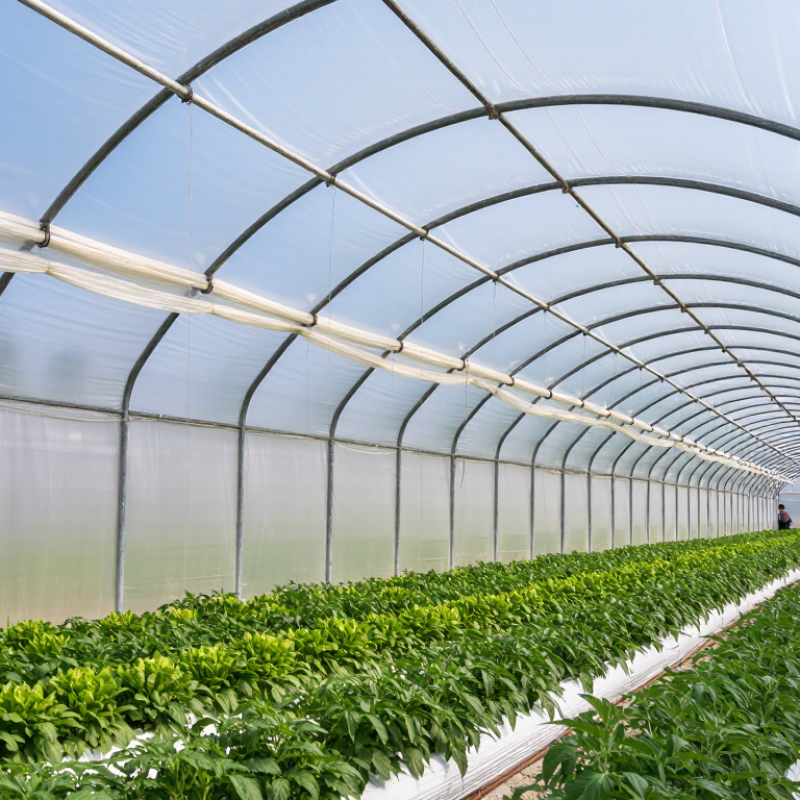
| Standard Greenhouse Film | Polyethylene (PE), commonly supplied as a single-layer or co-extruded film | About 80–200 μm | Lightweight, flexible, and widely used for seasonal or general-purpose covering. Performance depends on the resin blend, additives, and film thickness. | Tunnels, walk-in greenhouses, and basic crop protection structures | Compare expected service life, local wind and weather exposure, installation method, and the film’s stated light-transmission properties. |
| UV-Stabilized Film | PE or another greenhouse-film polymer with ultraviolet stabilizers | About 100–200 μm | UV stabilizers are designed to slow sunlight-related degradation. Actual durability varies with formulation, climate, chemical exposure, and installation. | Greenhouses exposed to strong sunlight or intended for extended use | Ask for the intended service-life conditions and confirm compatibility with crop-protection chemicals and greenhouse treatments. |
| Anti-Drip / Anti-Fog Film | PE-based film with an anti-condensation additive or treated inner surface | About 100–200 μm | Encourages condensation to spread into a thinner layer rather than forming large droplets. Additive performance can change over time. | Covered growing areas where dripping onto plants is a concern | Confirm which side faces inward and follow handling instructions; surface treatments may be affected by dust, cleaning, and aging. |
| Thermal / IR-Blocking Film | PE or multi-layer co-extruded film formulated with infrared-retention additives | About 120–200 μm | Designed to reduce the loss of certain long-wave infrared radiation at night. The effect depends on the film formulation and greenhouse conditions. | Greenhouses where nighttime heat retention is a priority | Request test data for thermal properties and consider the local climate, ventilation, and heating system. |
| Diffused-Light Film | PE-based film with light-diffusing additives or a textured surface | About 120–200 μm | Scatters incoming light to distribute it more evenly inside the growing space. Total light transmission and diffusion level are separate properties. | Crops or structures where more uniform light distribution is desired | Compare measured light transmission and haze or diffusion data; excessive diffusion or reduced transmission may not suit every crop. |
| EVA Greenhouse Film | Ethylene-vinyl acetate (EVA), sometimes blended or co-extruded with other polymers | About 100–200 μm | Can offer flexibility and optical properties suited to greenhouse applications. Performance varies with EVA content, additives, and construction. | Greenhouses and tunnels requiring flexible covering film | Check product-specific data for light transmission, anti-drip behavior, UV stabilization, and compatibility with the intended structure. |
| PO / Multi-Layer Co-Extruded Film | Polyolefin-based film produced in multiple layers, with layer functions varying by formulation | About 100–200 μm | Different layers can be formulated for properties such as durability, light management, or condensation control. “PO” composition and performance are not identical across products. | Commercial greenhouses and tunnels with specified performance requirements | Request the layer structure, polymer description, and test results rather than relying on the product category name alone. |