
Call Us

(905) 670-0113

7 Best Multi Function Induction Cookers for Global Buyers

Choosing an induction cooker for an international kitchen involves more than comparing power levels or attractive controls. A Multi Function Induction Cooker may offer preset programs, temperature adjustment, timers, and compact storage, but those features matter only when they suit your everyday cooking. Think of simmering soup in a small pot, boiling water after work, or wiping spills from a smooth glass surface. Practical details can matter more than a long feature list.

This guide introduces seven options for global buyers, with attention to cooking functions, usability, and purchase checks. Compare each model’s voltage, frequency, plug type, and rated power with your local supply before ordering. Check whether its cooking surface works with your cookware; a simple magnet test can help identify compatible ferrous-bottom pans. Also review the manual, warranty terms, and any relevant safety certifications for your market. Availability and specifications can vary by region, so confirm them with the seller or manufacturer.

No single cooker fits every kitchen. A powerful model may heat quickly, yet feel less convenient in a small space. Preset menus can save time, though they may not replace careful heat adjustment for delicate recipes. Product descriptions do not always reveal how controls feel during daily use. That deserves a second look. Use the comparisons below as a starting point, then match the features to your cookware, meals, counter space, and local electrical requirements.
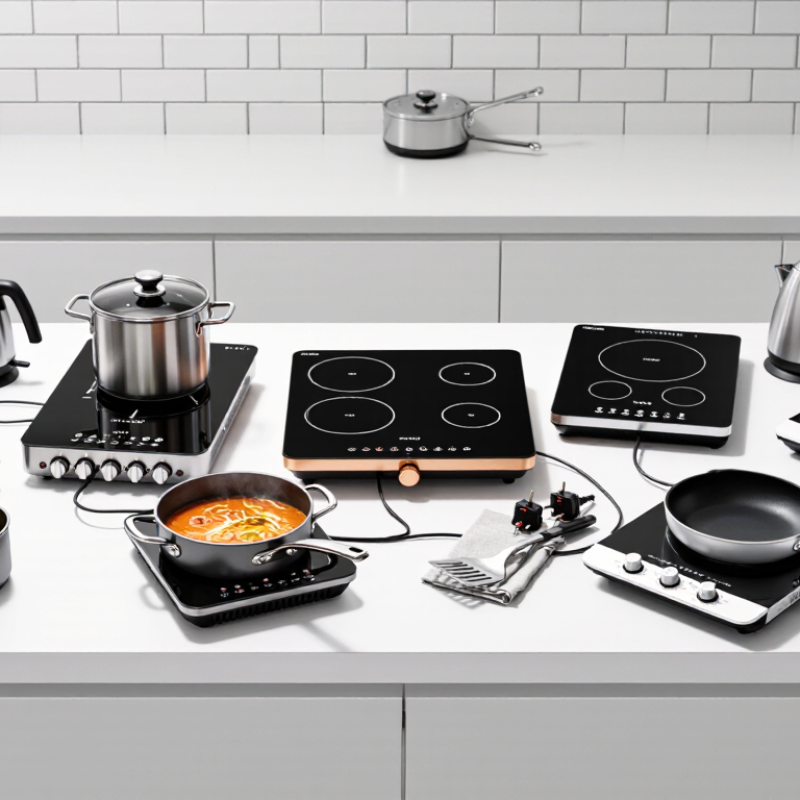
7 Best Multi Function Induction Cookers for Global Buyers

What Multi-Function Induction Cookers Are and How They Work

A multi-function induction cooker combines a magnetic heating surface with controls for tasks such as boiling, simmering, frying, or keeping food warm. The available modes vary by model; “multi-function” does not guarantee every cooking method. The label can mislead.

Inside the cooker, an electric current creates a changing magnetic field beneath the glass surface. When compatible magnetic cookware sits above it, the pan heats directly. The cooking surface itself usually stays cooler than the pan, though residual heat can remain. A small detail matters: cookware must have a magnetic base, so a simple magnet test can help check compatibility.

The U.S. Department of Energy’s Energy Saver guidance estimates that induction transfers about 85% of its energy to cookware, compared with roughly 32% for gas cooking. This helps explain its quick response and reduced wasted heat, but results depend on the pan, settings, and cooking habits. Touch controls, timers, and temperature presets can make routine meals easier to manage. Still, presets are not perfect substitutes for attention; a thin pan can heat unevenly, and sauces may need stirring. The technology is precise, not magical.

Multi-Function Induction Cookers: How They Work

Induction cookers create a changing magnetic field that heats compatible cookware directly. Many models combine cooking functions such as simmering, boiling, and temperature control in one appliance.

Approximate cooking-energy transfer estimates: induction about 85%, electric resistance about 75%, and gas about 32%. Actual efficiency varies with the appliance, cookware, and cooking conditions. Induction requires cookware with a magnetic base.

Key Features That Distinguish Multi-Function Induction Cookers

A multi-function induction cooker earns its place through useful control, not a crowded menu of buttons. Look for clearly separated settings for simmering, boiling, frying, and warming. Responsive power adjustment helps prevent soup from bubbling over or delicate sauces from scorching. Small changes matter.

Pan detection is another practical feature. The cooker should heat only when suitable cookware is present and pause when a pan is removed. Check the manual for compatible base materials and minimum pan size; “induction-ready” does not guarantee every pot will work well. A stable temperature reading is helpful, though displayed settings may not match the food’s exact temperature.

For global buyers, verify the rated voltage, frequency, plug type, and wattage before ordering. A plug adapter alone does not correct an electrical mismatch. A timer, child lock, and clear error indicators can make daily use safer and less frustrating. A smooth glass surface wipes clean easily, but spills around touch controls can still cause problems. Fan noise is worth checking, too, especially in a small, quiet kitchen. I would not choose solely by the number of cooking modes; a few reliable settings are often more useful than a long list that behaves inconsistently.

How to Evaluate Cookers for Different Global Markets

Choosing a multi-function induction cooker for another market takes more than comparing wattage and preset menus. Check the rated voltage and frequency against the destination’s household supply, and confirm that the supplied plug and cord are intended for that region. A mismatch can make a cooker inconvenient or unsuitable. Local electrical certification also matters; verify the exact model, not just the product category.

Test the cooking experience with the cookware people actually use. Induction requires a magnetic, reasonably flat base, so a simple magnet check can help screen pots before purchase. Compare the cooking zone with common pot sizes, then look at power settings, timer controls, and functions such as simmering or steaming. A bright display may be easy to read in a showroom but harder to use in a dim kitchen. Small detail, big difference.

Think about daily use and support, too. Are controls and manuals understandable to local users? Can replacement parts and service be found nearby? Check the cooker’s footprint against real counter space, and consider how easily its surface wipes clean after a starchy boil-over. Product ratings offer clues, but they rarely reflect every household’s cooking habits. That part is imperfect. A menu built around one cuisine may feel awkward elsewhere, so assess each function with familiar recipes rather than trusting the preset count alone.

7 Best Multi Function Induction Cookers for Global Buyers - How to Evaluate Cookers for Different Global Markets

Cooker Type Typical Rated Input* Common Supply Considerations Useful Functions Global Buyer Evaluation
1. Portable single-zone induction hob About 1.2–2.2 kW Models are designed for specific mains supplies, commonly around 120 V or 220–240 V. Check the rating label and plug type. Power or temperature levels, timer, keep-warm setting, automatic pan detection A practical choice for small kitchens and travel use within the appliance’s approved voltage range. Do not assume a plug adapter converts voltage.
2. Portable dual-zone induction hob Often about 2.8–3.5 kW total Total power may be shared between zones. Confirm circuit requirements, plug rating, and whether both zones can operate at full output together. Independent zone controls, timers, power boost on some models, pan detection Compare the maximum combined load with local socket and circuit limits, especially in markets with lower-capacity household outlets.
3. Built-in two-zone induction cooktop Commonly about 3.0–4.5 kW total May require fixed wiring or a suitably rated dedicated circuit. Installation requirements vary by country and model. Touch controls, residual-heat indicators, timer, child lock, power management on some models Check cut-out dimensions, ventilation clearances, wiring instructions, and local electrical installation rules before purchase.
4. Built-in four-zone induction cooktop Often about 6–7.4 kW total, with variation by model May use a dedicated single-phase circuit or a multi-phase connection, depending on the appliance and local supply. Multiple cooking zones, timers, bridge zones on some models, pan detection, safety shut-off A common full-kitchen format. Verify available circuit capacity and whether the hob supports a configurable power limit.
5. Five-zone or wide-format induction cooktop Often about 7–11 kW total, depending on zone size and power management Higher total demand may require a dedicated circuit and, in some markets, a multi-phase connection. Several cooking zones, flexible or bridge areas on some models, timers, residual-heat indicators Best suited to kitchens with sufficient electrical capacity. Check countertop dimensions and the installation manual before ordering.
6. Induction-heating rice cooker Typically around 0.7–1.5 kW, varying with capacity and design Choose a version rated for the destination market’s voltage and frequency; household rice cookers are not automatically dual-voltage. Rice programs, keep-warm, delayed start, and menu presets; exact options vary by model Check bowl capacity, menu language, measuring units, replacement-bowl availability, and local service support.
7. Induction multi-cooker with pressure-cooking capability Often about 0.8–1.5 kW for household models; check the product rating Confirm destination-market voltage, frequency, plug, and applicable pressure-cooker safety certification. May combine pressure cooking, slow cooking, sautéing, steaming, and keep-warm functions Compare usable capacity, pressure settings, removable-part availability, and whether the manual and safety information suit the destination market.

*Power figures are indicative ranges for common household appliance categories, not guaranteed specifications. Ratings and installation requirements vary by model and market. Always check the appliance nameplate, manual, local electrical requirements, and compatible cookware. Induction cookware generally needs a magnetic base; a magnet that sticks firmly to the base is a useful basic check.

Seven Multi-Function Induction Cookers Compared

Seven Multi-Function Induction Cookers Compared

This comparison looks at seven useful cooker profiles: compact single-zone, dual-zone, flex-zone, high-power, low-wattage, precision-simmer, and preset-led models. A compact unit suits a small counter, while a flex zone can better fit a long griddle. Dual-zone designs let a cook simmer sauce while boiling vegetables. Presets may simplify steaming or slow cooking, but they cannot replace well-calibrated temperature control. Small details matter.

The U.S. Department of Energy’s Energy Saver guidance says induction cooking can be up to three times more efficient than gas and about 10% more efficient than conventional smooth-top electric cooking. These figures describe cooking efficiency, not guaranteed household savings. Pan size, cookware compatibility, cooking time, and local electricity prices all affect results. A useful comparison tests each cooker with the same pan and water volume, then checks how steadily it simmers. Rankings can still miss real kitchen habits.

Tips: Before buying, confirm the usable cooking-zone diameter and control layout. Try adjusting heat with one hand; crowded buttons can be frustrating. Check whether the cooker includes overheat protection and a clear timer. Note the limitation: some preset menus offer convenience, but fewer manual adjustments.

Matching Cooker Features to Regional Needs and Cooking Habits

A multi-function induction cooker is most useful when its settings match everyday meals, not just a long feature list. In rice-focused households, steady low heat and a reliable keep-warm mode can matter more than rapid searing. For soup, beans, or slow-braised dishes, look for precise simmer control and a timer that is easy to set. Small details count. A clear display helps when the kitchen is dim or busy.

Cooking habits vary by region and household. People who often stir-fry may need a broad cooking zone and responsive heat changes, while compact homes may benefit from a lightweight unit that stores upright. Check that commonly used pots have magnetic, flat bases; some cookware will not work well. Also confirm the cooker’s voltage, plug type, and rated power suit the destination. High wattage can be inconvenient where kitchen circuits are limited.

Extra functions can save counter space, but they are not automatically an advantage. A cooker with preset programs may simplify familiar recipes, yet fixed settings can be frustrating when ingredients or portion sizes differ. I would compare the controls using a real routine: a morning pot of rice, a quick pan of vegetables, or a late simmering stew. One trade-off remains. The most versatile model may be harder to clean, so inspect the surface, edges, and removable parts before choosing.