
Industrial teams use Laser Cleaning Equipment to remove rust, paint, oil, and surface residue without relying on abrasive blasting. The right system can help prepare welds, maintain molds, or clean metal parts with greater control. But results depend on more than the laser source. Material type, coating thickness, working distance, and operator technique all affect the outcome.
This guide reviews seven options for industrial use, from portable units for on-site repairs to higher-output systems designed for demanding production work. It considers practical details such as laser power, pulse settings, cooling, controls, extraction needs, and service support. A compact machine may fit easily beside a workbench, while a larger system may suit repeated cleaning across a production shift. Neither is automatically better. Buyers should also check sample results on their own materials and ask suppliers about training, maintenance, and operating costs. Specifications can look persuasive on paper, yet real shop-floor conditions may expose limits that a brochure does not show. That matters. The comparisons here are intended to clarify trade-offs, not promise identical results for every factory. Even a careful shortlist can miss what operators value most: setup time, ease of handling, or a reliable local service contact. Use the recommendations as a starting point, then match each system to the task, workspace, and people who will use it.
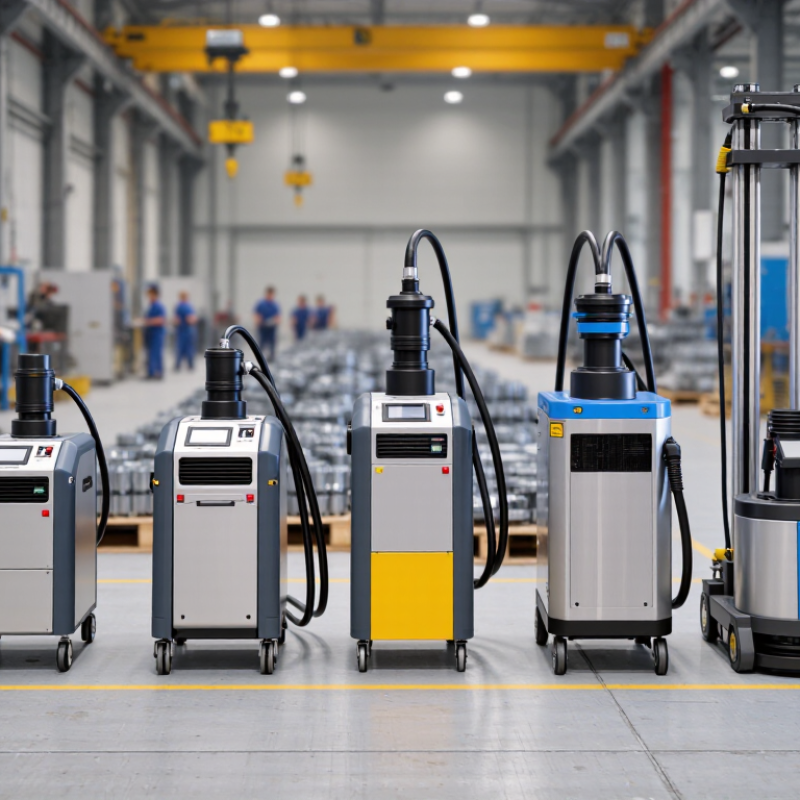
Industrial laser cleaning removes rust, oxide layers, paint residue, and other contaminants by directing controlled light onto a surface. The contaminant absorbs the laser energy and heats rapidly. It may vaporize, break apart, or lose its bond with the underlying material. A nozzle then carries the released material away, often with local fume extraction. No abrasive media. The workpiece can remain largely intact when the process is properly tuned, but results depend on the material and its condition.
Operators adjust pulse energy, scan speed, spot size, and distance from the surface. A rusty steel bracket may need different settings from a thin aluminum panel. Too little energy can leave dark patches behind. Too much can discolor or damage the substrate. That distinction is easy to underestimate. Before production, technicians should test a small, representative area and inspect it under good lighting. They should also check for heat-sensitive coatings, joints, and nearby components. Extraction matters because loosened particles and fumes should not simply drift across the shop. Laser cleaning can reduce consumables and manual scrubbing, yet it is not automatically the best choice for every job. Real surfaces vary, sometimes frustratingly; a clean test patch does not guarantee uniform results across a large part.
| Equipment type | Typical configuration | How it removes contaminants | Common industrial uses | Main advantages | Key considerations |
|---|---|---|---|---|---|
| Handheld pulsed-fiber cleaner | Portable pulsed fiber source; commonly available in power classes from tens to several hundred watts. | Short pulses heat or ablate a thin contaminant layer. The resulting thermal stress and material ejection help detach rust, oxide, oil, or paint from the surface. | Maintenance, weld preparation, tooling, and localized cleaning of metal parts. | Flexible for on-site work and small-to-medium areas; pulsed operation can limit heat transfer when parameters are properly selected. | Cleaning speed and substrate impact depend on pulse settings, scan pattern, material, and contaminant thickness. |
| High-power pulsed-fiber system | Industrial pulsed-fiber source, often in the several-hundred-watt range or higher, with a scanning head. | Higher average power and rapid scanning increase the area that can be treated while pulses act on rust, scale, or coatings. | Production cleaning of metal components, large fabrication parts, and recurring maintenance jobs. | Higher potential throughput than lower-power pulsed systems, while retaining pulsed operation. | Requires process trials to balance removal rate, surface finish, and heat input; suitable extraction and laser-safety controls are essential. |
| Continuous-wave (CW) fiber cleaner | Continuous-wave fiber source; industrial systems are available from hundreds of watts to multi-kilowatt power levels. | A continuous beam delivers heat to the surface, helping loosen or vaporize contaminants as the beam scans across the workpiece. | Fast removal of rust, scale, and some coatings from robust metal surfaces and larger work areas. | Can provide high cleaning rates on appropriate materials and contaminant layers. | Generally introduces more continuous heat than a pulsed process. Check for warping, discoloration, or other heat-sensitive effects on the substrate. |
| UV precision laser cleaner | Pulsed ultraviolet source, commonly based on a 355 nm wavelength; available power and pulse characteristics vary by system. | UV energy can be absorbed by certain surface films and residues, enabling localized removal with a small treatment area. | Precision cleaning of selected components, fine surface residues, and applications where a controlled, small-area process is required. | Useful for fine-feature work and targeted cleaning when the material and residue respond well to the selected wavelength. | Not a universal substitute for infrared fiber cleaning; confirm compatibility through testing because results depend on the substrate and contaminant. |
| Robotic laser-cleaning cell | Laser source paired with an industrial robot, programmed scan paths, fixtures, and a guarded work area; source type and power are process-specific. | The robot moves the scanning head along repeatable paths so the beam treats defined surfaces consistently. | Repeated cleaning of weld seams, formed components, tools, and parts with complex geometry. | Supports repeatability and reduces the need for an operator to hold the cleaning head during each cycle. | Needs process programming, part positioning, guarding, interlocks, and validation for each workpiece and cleaning recipe. |
| Conveyor or inline cleaning system | Enclosed or guarded laser station integrated with a conveyor or production line; laser source and power depend on line speed and part requirements. | Parts pass through a defined beam zone, where scanning optics treat selected surfaces as part of the production flow. | High-repeatability cleaning before coating, bonding, welding, or assembly in production environments. | Can be integrated with automated handling and inspection for consistent cycle-to-cycle processing. | Line speed, part orientation, beam coverage, fume extraction, and guarding must be engineered together. |
| Large-area gantry or multi-axis system | Laser head mounted on a gantry or multi-axis motion platform; source type, power, and working envelope are selected for the job. | Controlled motion moves the beam across large, flat, or extended surfaces using planned scan paths. | Large plates, molds, industrial equipment, and workpieces that are difficult to clean by hand. | Provides repeatable coverage over a larger work area and can reduce manual repositioning. | Requires adequate floor space, secure workholding, motion planning, and a suitable enclosure or controlled laser-safety area. |
Note: Power ranges and configurations are representative, not universal specifications. Actual cleaning performance depends on laser parameters, substrate, contaminant, surface condition, and scan strategy. Industrial laser cleaning can generate hazardous beams and airborne fume or particles; use appropriate guarding, wavelength-rated eye protection, and fume extraction.